Minnetonka Wood Flooring brings more than 20 years of sanding and installing hardwood to wood flooring in Mounds View, and much of our work here is for owners who rent their property out. A rented floor in this city answers to a yearly inspection, so we plan sanding, refinishing and board replacement around the license calendar rather than a loose someday. Owner-occupied homes get the same written quote and the same care.
The first visit settles the facts a quote depends on. We read indoor relative humidity with a hygrometer and write it on the quote, then check the subfloor for squeaks and soft spots. You get a written price per square foot, with a screen and recoat and a full sand and refinish priced next to each other.
For a landlord, the useful part is timing. A recoat can often be done between tenants in a short window, while a full sand needs more days for sanding, finish and cure time. We put the cure time and the day furniture can return in writing, so a move-in date and an inspection date do not land on a wet floor.
Mounds View’s Rental License and the Yearly Inspection

City Code Chapter 119 is blunt about scope: every rental dwelling, including single-family rental dwellings, must be licensed. That covers a duplex unit, an apartment and a rented house on a quiet street alike. If you collect rent on a property in Mounds View, the floors inside it are part of a licensed dwelling the city expects to see each year.
Renewal Runs on an Annual Clock
Licenses are renewed annually, and the application is due 30 days before the renewal date. The 2025 licenses expire on December 31. We suggest owners treat the renewal as a planning marker for floor work too, since a refinish booked in a rush tends to collide with holidays and tenant schedules. Contact Code Enforcement at (763) 717-4023 with license questions; we handle the floors.
Inspections Run February Through October
An inspection is required each year as part of licensing, typically conducted between February and October. That window is generous, but it also overlaps the end of furnace season, when indoor air in a Minnesota house sits below the thirty to fifty percent relative humidity band wood flooring is built for. Boards shrink in dry air and open seasonal gaps that look worse in March than in August.
The humidity reading from our first visit lets an owner tell a seasonal gap from a real defect before anyone spends money. If the inspection slot is early in the year, we may advise a light screen and recoat now and a full sand in summer, when the wood has settled back toward its equilibrium moisture content.
Booking Floor Work Ahead of the Inspector
The city publishes a Rental Property Checklist to help owners prepare, and it is worth reading before you call us. We do not guess at what an inspector will write up. What we can do is fix the floor problems a tenant notices first: a soft spot near a doorway, loose boards, a raised nail pop, or finish worn through to gray wood in a hallway.
Booking that work in winter or early spring gives a full sand and refinish time to cure before the inspection date. Waterborne polyurethane usually allows light foot traffic sooner than oil-modified polyurethane, which matters when a unit has to be shown or occupied quickly. Hardwax oil is an option too, since a worn traffic lane can be spot-repaired later without sanding the whole room.
Looking for wood-flooring closer to Waconia? See Waconia Wood-Flooring.
Free Inspections, $100 Re-inspections and License Discounts
The city’s fee structure rewards getting it right the first time. Mounds View charges nothing for the first inspection or for a follow-up inspection; additional re-inspections are $100 each. Any item still open after the follow-up becomes a recurring cost, which is the main financial argument for fixing floors properly once.
Patching Versus Refinishing
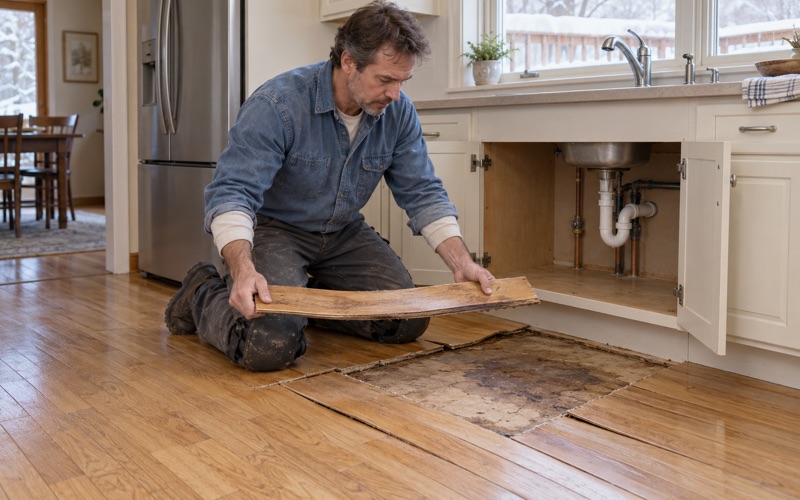
A quick patch can look fine on inspection day and fail by the next one. Cupping around a leaking dishwasher, buckling near a patio door, or a squeak over a loose subfloor all come back if the cause is ignored. We take readings with a pin moisture meter and a pinless moisture meter before we quote a repair, and we record them.
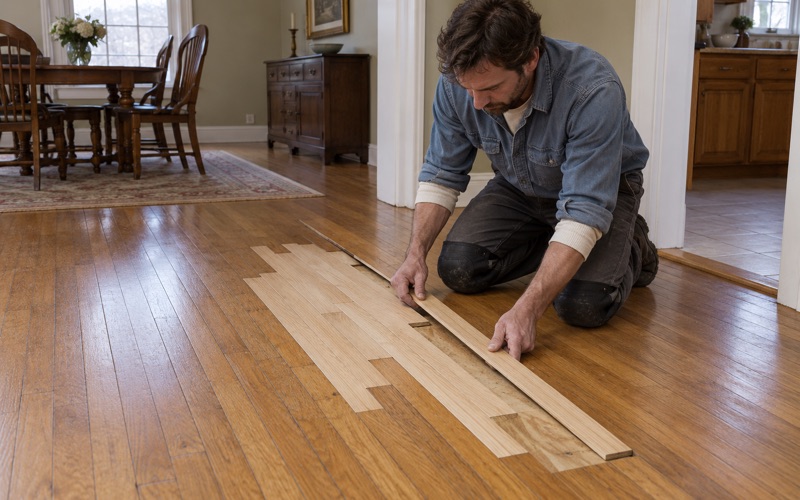
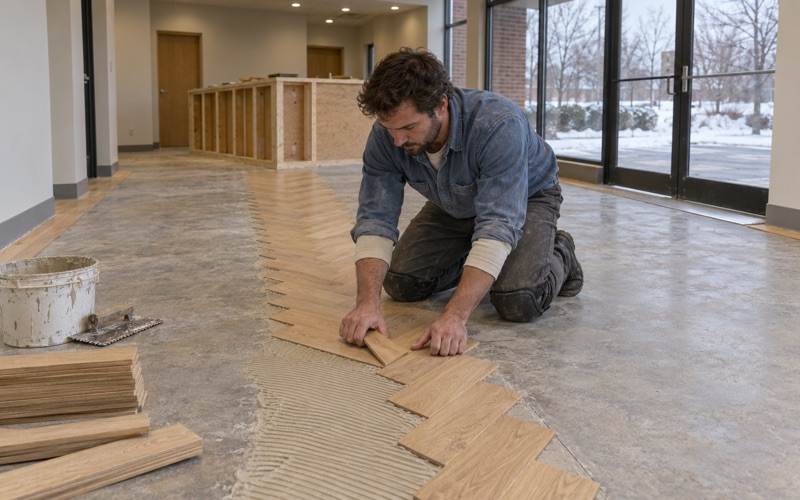
When boards are damaged beyond sanding, we do a board replacement with lacing, weaving new boards into the old pattern so the repair does not read as a rectangle. On engineered flooring we measure the wear layer first; if there is not enough left for a sand, we say so before promising one, and price a recoat or replacement instead.
Crime Free Multi-Housing and the License Fee
Owners in the Crime Free Multi-Housing program receive license fee discounts of up to 50 percent. The city ties licensing to properties that are safe, secure and sanitary, and floor condition is part of how a unit presents on that score. A discount on the license does not change what the floor needs, but it can free budget toward doing the floor right.
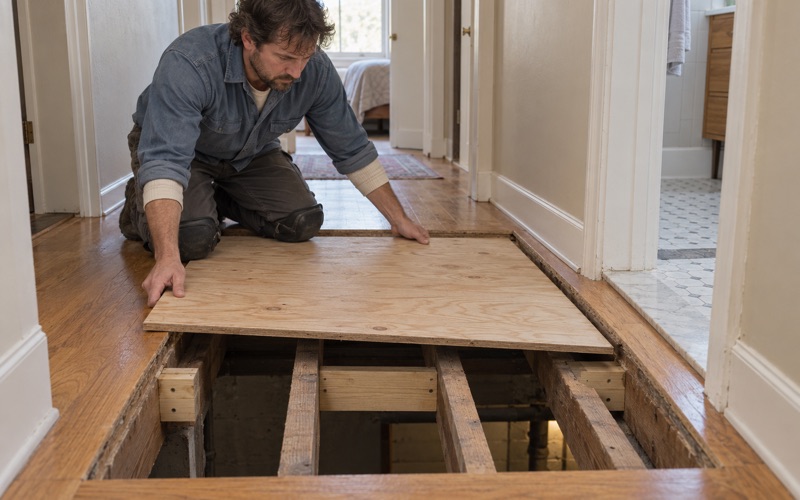
We price subfloor and structural repair as its own line, separate from sanding and finish. That lets an owner fix a soft spot over a joist this year and schedule the refinish for next year’s cycle, with both numbers on paper. Stairs are quoted per tread and riser, which keeps a worn common stairway from hiding inside a square-foot figure.
Single-Family Rentals and Why the City Licenses Them
In February 2008 the City Council adopted Ordinance 802, which extended rental licensing to all rental properties as more single-family homes were converted to rentals. Owners must also complete at least one training option as part of licensure. The American Community Survey counts 126 renter households in single detached houses, but those houses carry owner-style floors under tenant-style wear.
Older Houses and the Lead-Safe Rule
Mounds View’s housing grew fast after World War II, and 3,570 of its 5,698 housing units, or 62.7 percent, predate 1980. The 1970s were the largest build decade, at 29.1 percent of units. A converted house from that era may have original oak under carpet, which can be a good candidate for a full sand and refinish once the tack strip and staples are pulled.
Pre-1978 housing falls under the federal EPA Renovation, Repair and Painting rule when work disturbs paint, and Minnesota is not an EPA-authorized state, so the federal rule governs directly. Sanding a floor in a painted room can disturb baseboard and trim paint. We describe our containment by the equipment used, sealed openings, a HEPA vacuum and cleanup steps, rather than calling it dustless.
Lower Levels in Converted Houses
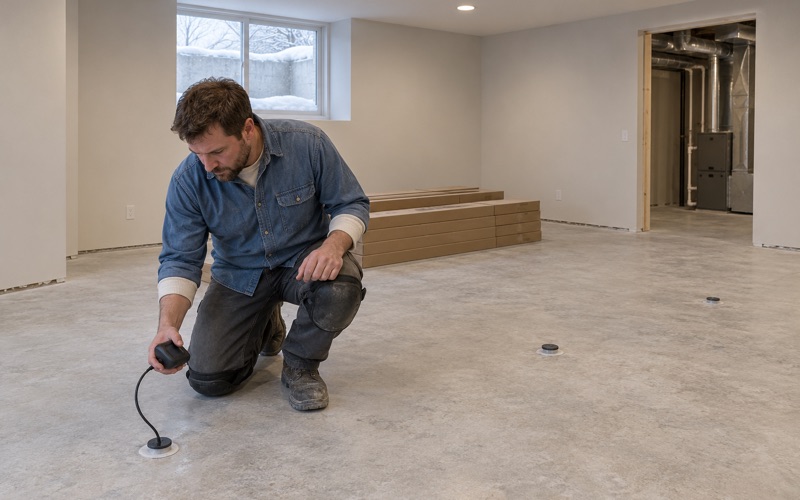
A rented house with a finished lower level raises a different question. We decide grade with the three-inch soil rule, so a walkout lower level is quoted as below grade when the soil line says it is, and solid hardwood is not promised for a slab that cannot carry it. Moisture readings on the slab itself are recorded before a board goes down.
For a slab, that can mean an in-situ relative humidity test under ASTM F2170 rather than a surface guess, plus a vapor retarder chosen to match the result. Engineered flooring, glued down or floating, is usually the better fit below grade. A practical rental choice there pairs a harder species, such as hickory or hard maple, with a finish that tolerates boots and pet nails.
Turnover-Ready Floors in Mounds View Apartment Buildings
Most of the city’s renters live in multi-unit buildings rather than houses. Of 1,653 renter households, 414 live in structures of fifty or more units, 358 in buildings of twenty to forty-nine units and 302 in buildings of ten to nineteen. For owners of those buildings, floor turns between tenants are a regular line in the budget.
Screen and Recoat Between Tenants
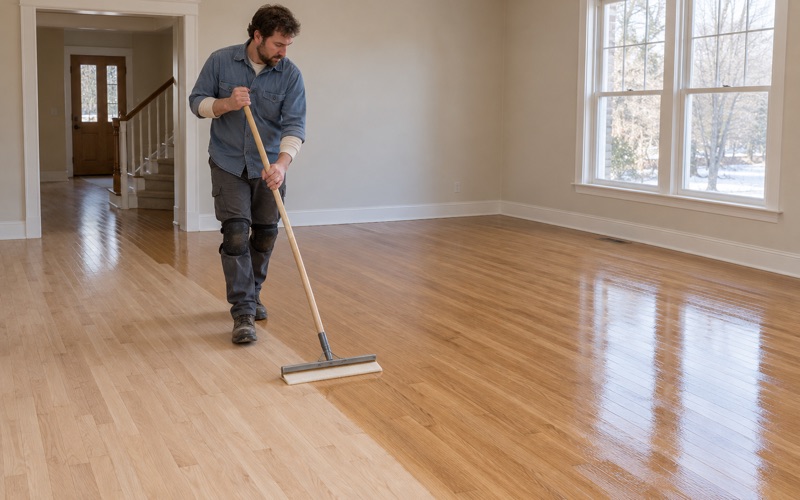
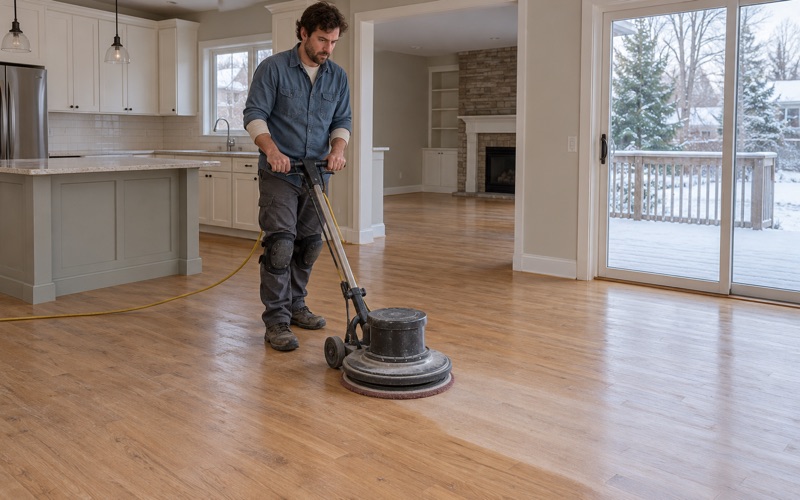
When the finish is worn but the wood is intact, a screen and recoat is the fastest turn we offer. We abrade the existing finish with an abrasive screen on a buffer, vacuum, and apply a fresh coat within the product’s recoat window. A unit can often be back in service within days, though the written cure schedule decides when rugs and furniture return.
A recoat only bonds to clean, compatible finish. Floors that have been treated with wax or some polish products may need a full sand instead, and we test before committing. Where pet damage, deep scratches or dark water stains reach the wood, a full sand and refinish with a 36-50-80 grit sequence on a drum sander and edger is the honest answer.
Sound Between Stacked Units
Replacing carpet with wood in an upper-floor unit changes what the neighbor below hears. Before we schedule that work, we read the building’s rules, or the association documents for a condominium, and match the acoustic underlayment to what the building requires. Impact insulation class and sound transmission class ratings belong to the whole floor-ceiling assembly, so a product label alone does not settle it.
For a duplex or townhouse rental, Minnesota retains IRC Appendix K, which sets STC 45 and IIC 45 for two-family dwellings and townhouses under Minnesota Rules 1309.0302. Painting, tiling, carpeting and similar finish work are exempt from permit under Minnesota Rules 1300.0120, though the exemption does not authorize work that violates the code. Structural work goes through the City of Mounds View Community Development Department, which issues permits directly.
Leaks, Claims and the Next Inspection
Apartment floors can take water from above: a failed supply line, a frozen pipe in an exterior wall, an overflowing tub upstairs. When that happens we photograph and moisture-map the floor for the insurance claim before drying or tear-out begins, so the adjuster sees the damage as it was. That record also tells the owner which boards can be saved.
Timing matters here too. A floor that is still drying can show cupping for weeks, and sanding it flat too early leaves it crowned once the boards dry out. We track readings until the wood returns near its normal moisture content, then refinish, which may mean telling an owner to plan around the inspection date rather than rushing to beat it.
- 20+ Years on Wood Floors
- Per-Square-Foot Written Quotes
- Stairs Priced Per Tread