
Minnetonka Wood Flooring has repaired hardwood floor water damage in Minnetonka, MN for more than 20 years, serving surrounding cities including Hopkins, Wayzata, St. Louis Park, Edina and Eden Prairie. We document wet floors for the insurance claim, track them through drying, and then repair, replace and refinish the wood so the damaged area matches the rest of the house.
The first visit matters most. Before any drying equipment runs or any board comes up, we photograph the floor and map its moisture with pin and pinless moisture meters. That record shows the adjuster the damage as it was found, and it tells us which boards are likely to recover and which are not.
Our written scope keeps the parts of the job separate: drying monitoring, subfloor and structural repair, board replacement, and refinishing. You and your adjuster can see what each piece of the repair is and why it is needed.
Where Water Damage Comes From in Minnesota Homes
Ice Dams and Roof Leaks
In winter, an ice dam can trap meltwater at the roof edge and push it under the shingles. The water often runs inside a wall and appears at the base of an exterior wall or through a ceiling, soaking the floor along the baseboard before anyone sees a stain.
Because the leak can continue each time the snow melts, we check the floor along the full length of the affected wall, not just where the water first appeared. Moisture often travels farther under the boards than the visible staining suggests.
Frozen Pipes and Appliance Leaks
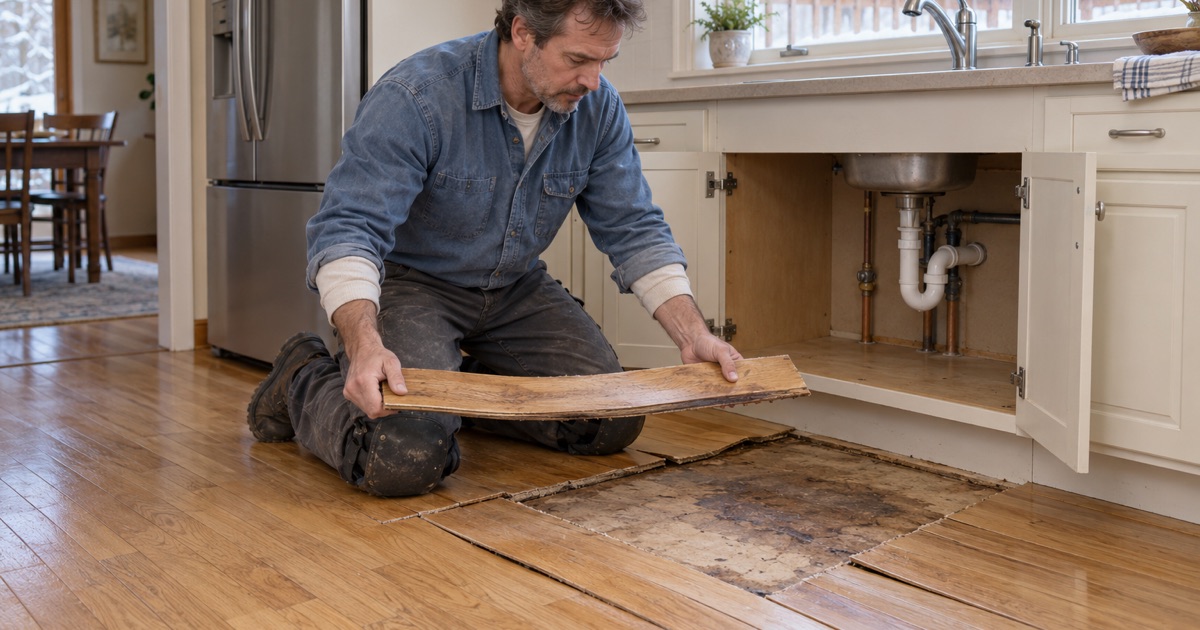
A frozen pipe that bursts in an exterior wall, a failed dishwasher hose, a leaking refrigerator water line or an overflowing tub can all put water directly onto or under a hardwood floor. A sudden burst is obvious; a slow drip under a cabinet can soak a subfloor for weeks before boards start to cup.
We trace the wet area outward from the source with moisture readings. Kitchen floors often run under cabinets and into adjoining rooms, so a small appliance leak can affect more square footage than it seems.
Basement Water and Sump Pump Backups
Below-grade floors face groundwater, heavy rain and sump pump failures. A sump pump backup or a sewer backup brings water up from below, often affecting both the flooring and any wall finishes near the floor.
These losses are handled differently under many homeowners policies, and backup coverage often depends on a separate sewer backup endorsement. We do not decide coverage, but we document the source and the extent of the damage so your agent and adjuster have accurate information.
Documenting the Damage for Your Claim
Photos and Moisture Maps Before Tear-Out
We photograph the floor from several angles, mark readings on a floor plan, and note the source of the water. Readings from an unaffected area of the same floor give a baseline, so the record shows not only that the floor is wet but how wet compared with its normal moisture content.
That documentation is done before drying starts or boards are removed. Once flooring is torn out, the extent of the damage is much harder to prove, and the discussion about how much floor needs replacing becomes harder too.
Like Kind and Quality Replacement
Minnesota Statutes 72A.201 sets standards for how insurers handle claims. Among them, a replacement-value settlement must cover like kind and quality, and depreciation may not be applied to items that are not adversely affected by age, use or obsolescence.
For a wood floor, like kind and quality means the same species, grade, width and finish. We identify each of those in writing, because a cheaper substitute that does not match the rest of the floor is not a like-for-like repair.
Matching Undamaged Rooms
A hardwood floor that runs continuously through several rooms raises a matching question when only part of it was wet. New boards finished in the damaged room alone will not match the aged floor next to them.
We describe the continuous floor, where it breaks at thresholds, and what would be needed to make the repair blend. That gives your adjuster the information to evaluate the matching issue under your policy.
Prefinished floors raise the same question in a different way. If the original product has been discontinued, a close substitute may still differ in color, bevel or sheen, and we note that in the scope so the replacement decision is made with the difference in plain view.
Drying, Saving or Replacing the Floor
Monitoring Moisture Content Through Drying
After the water source is fixed, the floor needs time and airflow to dry. We return to read the boards and the subfloor until the damaged area comes back close to the baseline readings from the dry part of the floor, which tells us the wood has returned near its equilibrium moisture content.
Rushing this step is the most common mistake. Boards that look flat at the surface can still hold moisture underneath, and covering or finishing them too early traps that moisture.
Cupping, Crowning and Buckling
Cupping, where board edges rise, often relaxes as the floor dries, and moderate cupping can be sanded flat once it does. If the floor is sanded while still cupped and wet, it will crown when it dries, leaving the center of each board higher than the edges.
Buckling is more serious. When boards swell enough to lift off the subfloor and break their fasteners, they rarely go back down properly. Buckled areas are usually replaced rather than dried in place. Removing them promptly can also help the subfloor beneath dry faster.
When Replacement Is the Right Call
We recommend replacing boards that have buckled, split or delaminated, boards with black staining from long exposure, and any area where mold has developed. We also replace subfloor that has swelled, delaminated or stayed wet too long to dry reliably.
When only part of a floor needs replacing, we lace new boards into the surrounding courses so the repair follows the existing pattern instead of forming a visible patch. The decision is written down board by board on a floor plan, so you and your adjuster can see why each area is being saved or replaced. If a section we expected to save fails to recover during monitoring, we update that plan in writing rather than quietly expanding the job.
Repairing and Refinishing After Water Damage
Subfloor Repair Under the Damaged Area
Water collects on the subfloor, and plywood or OSB that has swollen or softened will not hold fasteners properly. We cut out damaged sections, add support where needed, and install new subfloor, then read its moisture before any new flooring goes down. That structural work is priced on its own line.
We also look at the joists under a wet area when the basement ceiling is open or can be accessed. Framing that stayed wet can show staining, softening or mold, and finding that before new flooring goes down avoids opening a finished floor a second time.
Sourcing and Installing Matching Boards
We match the species, width, thickness and grade of the existing floor and acclimate the new boards in the house before installing them. For prefinished floors, we look for the same product or the closest available match in color and sheen.
New boards and old boards need to be at similar moisture content when they are installed. Installing dry new wood next to boards that are still recovering creates gaps or tight spots as both settle.
Refinishing for a Uniform Floor
On site-finished floors, we sand the repaired area together with the surrounding floor so new and old boards are finished at the same time. That is usually what makes a repair disappear, since even a perfect board match looks different under an aged finish.
We write the finish type, number of coats, dry time and the day furniture can return on the scope, so you can plan around the work and your adjuster can see exactly what was done.
- 20+ Years on Wood Floors
- Per-Square-Foot Written Quotes
- Stairs Priced Per Tread