
Minnetonka Wood Flooring has done hardwood floor repair in Minnetonka, MN for more than 20 years, serving surrounding cities including Hopkins, Wayzata, St. Louis Park, Edina and Eden Prairie. We replace damaged boards, quiet squeaks, rebuild soft spots and remove stains, then blend the repair so it does not read as a patch.
Good repairs start below the surface. We take moisture readings on the boards and the subfloor before cutting anything out, because a stain or a buckle that came from water will come back if the source is still wet.
The quote separates the two kinds of work. Subfloor and structural repairs go on their own line, the board replacement and finishing on another, so you can see exactly what the damage costs to fix and what the cosmetic blending adds.
Board Replacement and Weave-In Repairs
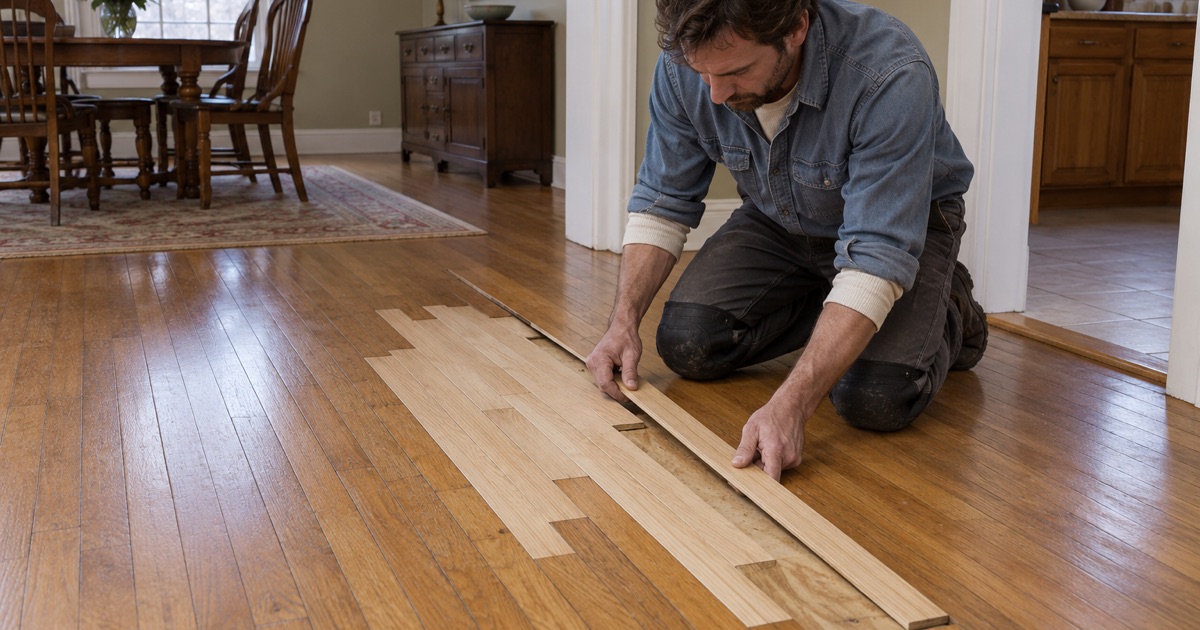
Lacing New Boards Into the Existing Floor
A proper repair does not cut a square hole and drop in a block of boards. We remove damaged boards one at a time and lace new ones into the existing courses, staggering the end joints the way the original installer did, so the repair follows the pattern of the floor rather than outlining a rectangle.
Each new board is fitted with its tongue and groove intact where possible. On the last board in a run, where the groove has to be modified to drop in, we glue and fasten it so it stays tight and does not rock or squeak later.
Matching Species, Width and Grade
Red oak, white oak, hard maple and hickory each look different, and so do different board widths and grades within the same species. Plain-sawn, rift-sawn and quartersawn boards show different grain as well. We match all of those before ordering, because the wrong grain pattern stands out even when the color is close.
Older floors sometimes use board widths or thicknesses that are no longer common. When we cannot source a match, we may borrow boards from a closet or other hidden area and put new wood there instead, which keeps the visible floor consistent.
Blending the Finish After a Repair
New wood is lighter than boards that have aged under an amber finish for years. On a site-finished floor, we usually sand and coat the whole room or the connected area so the repair and the original floor get the same finish at the same time.
On prefinished floors, we look for a replacement board with a matching factory finish and sheen. When the original product has been discontinued, we discuss whether a room-wide sand and refinish or a careful color match makes more sense.
Squeaks, Soft Spots and Loose Boards
Squeaks and Nail Pops
Squeaks usually come from wood rubbing on wood or on a loose fastener as the floor moves. A nail pop, where a fastener rises above the surface, often shows up after a dry winter when boards shrink around their nails. We reset or replace those fasteners and quiet squeaks from below where the joists are accessible.
Where the ceiling below is finished, we use small trim screws or specialty fasteners driven from above into the joist, then fill the holes to match. Most squeaks can be quieted this way without opening a ceiling.
Soft Spots and Subfloor Damage
A spongy area underfoot is not a flooring problem alone. It usually means the plywood subfloor or OSB subfloor has delaminated from an old leak, or a joist has cracked or lost its bearing. We remove the boards over the area, cut out the damaged subfloor, add blocking or sister the joist where needed, and lay new subfloor before replacing the flooring.
Because that structural work is priced separately, you can see what the hidden repair costs. If it turns out to be larger than expected once the boards are up, we stop and show you before going further.
Loose and Hollow-Sounding Boards
On glue-down engineered floors, a hollow sound or a board that moves often means the adhesive has released. We inject adhesive or replace the affected boards. On floating floors, a soft or bouncing area can mean the underlayment or subfloor is uneven, which we correct before relaying the boards.
Compression set is another cause of loose boards. When a floor swells tightly in a humid summer and then shrinks in a dry winter, the edges can crush permanently and leave boards that rattle or gap. We assess whether the gaps are seasonal or permanent before deciding between humidity control and board replacement.
Damage We Repair Most Often
Pet Stains and Water Marks
Dark pet stains and black rings from plant pots or radiators usually go deeper than any sander can reach. We cut those boards out and replace them. Lighter gray water marks that sit in the finish can sometimes be sanded out during a refinish, and we test before deciding.
Before replacing stained boards, we check the subfloor beneath them. Urine and long-standing water often reach the plywood or OSB, and leaving a contaminated or damp section under new wood means the odor or the moisture comes back through the repair.
Gouges, Dents and Burns
Deep scratches from furniture, dropped tools and burns from fireplaces or cigarettes can sometimes be sanded out locally. When they go deeper than the wear layer allows, or when the board is split, we replace the board. Softer woods dent more easily, which is one reason Janka hardness comes up when choosing replacement species.
For a single deep gouge, replacing one board is often cleaner than filling it. Wood filler rarely takes stain the same way the surrounding grain does, so a filled gouge in a stained floor can stay visible as a spot, while a laced-in board finishes with the rest of the room.
Buckled and Cupped Areas After a Leak
Boards that buckled or cupped from a leak need the moisture source fixed and the floor dried before any repair. We track moisture content until the area returns close to the rest of the floor, then decide which boards can be flattened by sanding and which have to come out.
If the leak is part of an insurance claim, we photograph and moisture-map the floor before anything is removed. That record shows the adjuster the extent of the damage as it was found, which matters later when the scope of the replacement is being agreed.
Powderpost Beetle Damage
Small exit holes with fine frass beneath can indicate powderpost beetles. We assess whether the activity appears current and recommend a pest professional when it does. Once the problem is treated, we replace boards that are structurally weakened.
Stairs, Thresholds and Transitions
Stair Treads and Nosing Repairs
A cracked stair tread, a loose nosing or a riser pulling away from its stringer is a safety issue as well as a cosmetic one. We repair or replace treads and nosing individually and quote stair work per tread and riser, so a stair repair is never lost inside a floor price.
Worn treads on an older stair are often refinished rather than replaced when enough wood remains. We sand them by hand or with an orbital sander, since a drum sander cannot reach the treads, and finish them to match the adjoining floor so the stair and the hallway read as one surface.
Thresholds, Reducers and T-Molding
Transitions take a lot of wear and often loosen first. We replace damaged thresholds, reducers, T-molding and quarter round, matching the species and finish to the floor so the doorway reads as part of it.
Patching Where Walls or Cabinets Were Removed
Opening up a room or removing a kitchen island often leaves a strip of bare subfloor in the middle of a hardwood floor. We lace in matching boards across the gap so the floor looks continuous, then refinish the area to blend old and new together.
- 20+ Years on Wood Floors
- Per-Square-Foot Written Quotes
- Stairs Priced Per Tread