
Minnetonka Wood Flooring has handled engineered hardwood refinishing for more than 20 years, and every engineered job starts with one measurement: the thickness of the hardwood wear layer. That number decides whether your floor can take a full sand and refinish, whether it can only be screened and recoated, or whether sanding would go straight through to the core.
We measure it before the quote is written, not after the sander is running. You get the reading on the quote along with a price per square foot for each option the floor can safely take, the finish we would use, and the day furniture and rugs can come back.
Engineered floors are common in newer houses, condominiums and basements, and many were sold as refinishable without saying how many times. Knowing exactly what is on top of the core is how we keep a refinish from turning into a replacement.
How Engineered Flooring Is Built
The Wear Layer and the Engineered Core
An engineered board is a layer of real hardwood bonded to a core of plywood, high-density fiberboard or another composite. The core gives the board stability, so it moves less than solid hardwood as humidity changes. Only the top hardwood layer, the wear layer, can be sanded.
Wear layers vary widely between products. Some premium boards carry enough hardwood for several full sands, while many budget products have a thin veneer that cannot safely be sanded at all.
Rotary-Peeled, Sliced and Sawn Faces
The way the face layer was cut affects how it looks and how it sands. Sawn faces look most like solid wood and usually sand the most predictably. Rotary-peeled faces show a wider, sometimes unnatural grain pattern and are often thinner. We identify the face type when we inspect the board edge.
Factory Finishes on Prefinished Boards
Most engineered flooring is prefinished, often with a hard aluminum oxide finish applied at the factory. That finish wears very well but makes recoating harder, because new finish does not bond easily to it. Some engineered products are site-finished instead, which behave much like solid hardwood when it comes to recoating.
Measuring Before Anyone Promises a Sand
Where We Look
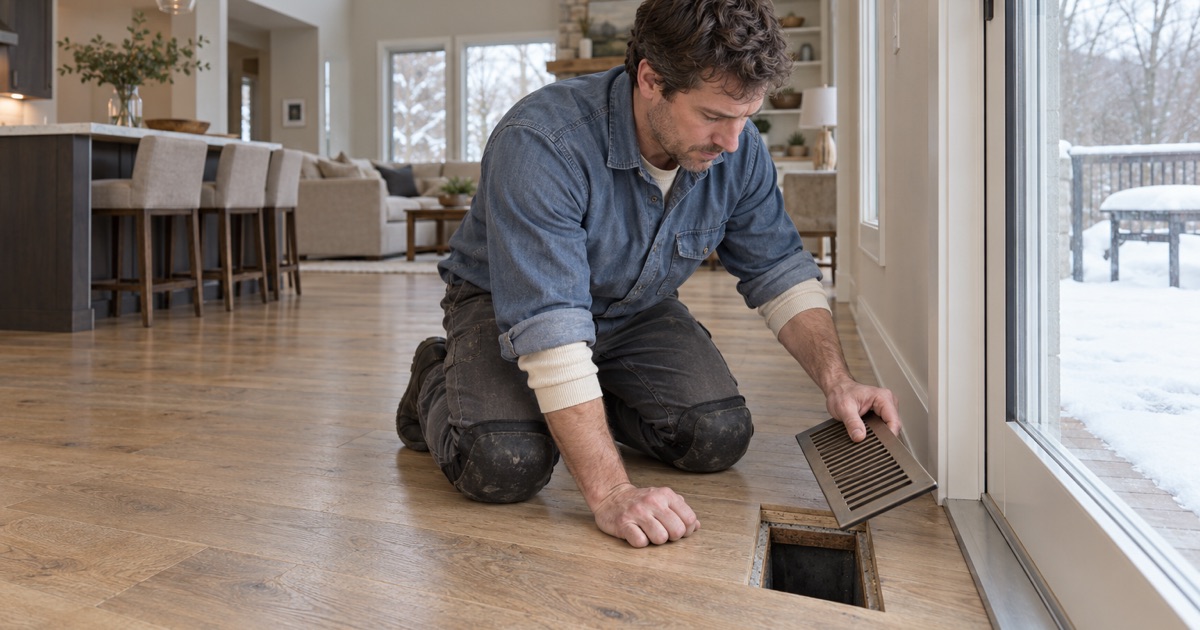
We remove a floor register, a threshold or a section of quarter round to expose a board edge. On a floating floor, we sometimes check at the end of a run near a wall. The cross section shows the wear layer, the bond line and the core, which tells us what the floor is made of and how much hardwood is available.
We record the measurement on the quote. If different areas of the house use different products, which happens after renovations and additions, we measure each one.
What the Measurement Decides
A thick wear layer can handle a full sand and refinish with fine grits and careful passes. A moderate layer may allow one light sand. A thin layer means a screen and recoat is the only safe refinishing option, and a damaged area may need board replacement instead.
We also consider bevels, existing wear and any previous sanding. A floor that has been sanded before has less wood left than its original specification, so the original product label is never the whole story.
Sand-Through Risk
Sand-through happens when the sander cuts through the wear layer and exposes the core. It cannot be fixed with finish, only with board replacement. On thin wear layers, it can happen in a single pass, especially at board edges, around bevels or where the floor is slightly uneven.
Refinishing Options for Engineered Floors
Screen and Recoat
A screen and recoat lightly abrades the existing finish with an abrasive screen on a buffer and adds a fresh coat of finish. It removes no meaningful amount of wood, so it suits engineered floors of any wear layer thickness, as long as the new finish bonds to the old one.
On factory aluminum oxide finishes, we abrade carefully and test adhesion in an inconspicuous area before recoating the whole floor. A recoat that does not bond will peel, so the test is not optional.
Full Sand and Refinish
Where the wear layer allows, a full sand removes the old finish, scratches and minor stains and lets you change the color or sheen. We use a lighter approach than on solid hardwood, starting at a finer grit when possible and keeping passes even, so we remove only as much wood as the floor needs.
After sanding, we apply stain if chosen and then finish coats. Waterborne polyurethane is a common choice for engineered floors because it stays clear and dries quickly, and we write the chemistry, dry time and cure time on the quote.
Board Replacement for Damaged Areas
When individual boards are dented, stained or sanded through, replacing them can be better than sanding the whole floor. Glue-down and nail-down engineered boards can usually be cut out individually. Floating floors can sometimes be disassembled back to the damaged boards from the nearest wall.
Living With Engineered Floors in Minnesota
Seasonal Movement and Humidity
Engineered flooring is more stable than solid hardwood but still responds to humidity. In furnace season, indoor air in a Minnesota house often drops below the thirty to fifty percent relative humidity range most manufacturers specify, which can cause small gaps, surface checking on the face layer, or edge separation.
We read the room’s relative humidity before refinishing and recommend keeping it within the manufacturer’s range afterward, often with a whole-house humidifier in winter. Finishing a floor during extreme dryness can make the result look worse once humidity returns.
Basements and Lower Levels
Engineered floors are often installed below grade because they tolerate moisture better than solid wood. Refinishing them follows the same rules, but we also check for signs of moisture from the slab, such as cupping or edge swelling, before deciding whether to refinish or address the moisture first.
- 20+ Years on Wood Floors
- Per-Square-Foot Written Quotes
- Stairs Priced Per Tread